bijan-fallah.com

Climate scientist · Berlin

I measure how far a climate number can be trusted.

Independent climate scientist. I quantify basis risk in parametric climate covers — the gap between what a weather index pays and the loss actually suffered — with wind and solar drought in Europe as the working case. Before that: data assimilation, paleoclimate reconstruction and neural downscaling, in peer-reviewed work since 2014.

Read the notes or write to me

Bijan Fallah, in profile against a sunlit brick wall.

Notes

Working write-ups with numbers — the analysis that does not fit in a paper and should not wait for one.

"Just re-tune the trigger" — and the 19% that won't go away

“Just re-calibrate the trigger” is the standard answer to basis risk. On ten years of European wind data, re-tuning does help, up to a point: the fairest available setting still misses roughly 6.7% of whole droughts and leaves about 19% of drought-hours unpaid.

2026-09-01

All notes →

Atlas

Static maps of Germany's wind resource, drawn from public reanalysis. Dated exhibits, re-drawn when the next full year lands — never a live feed.

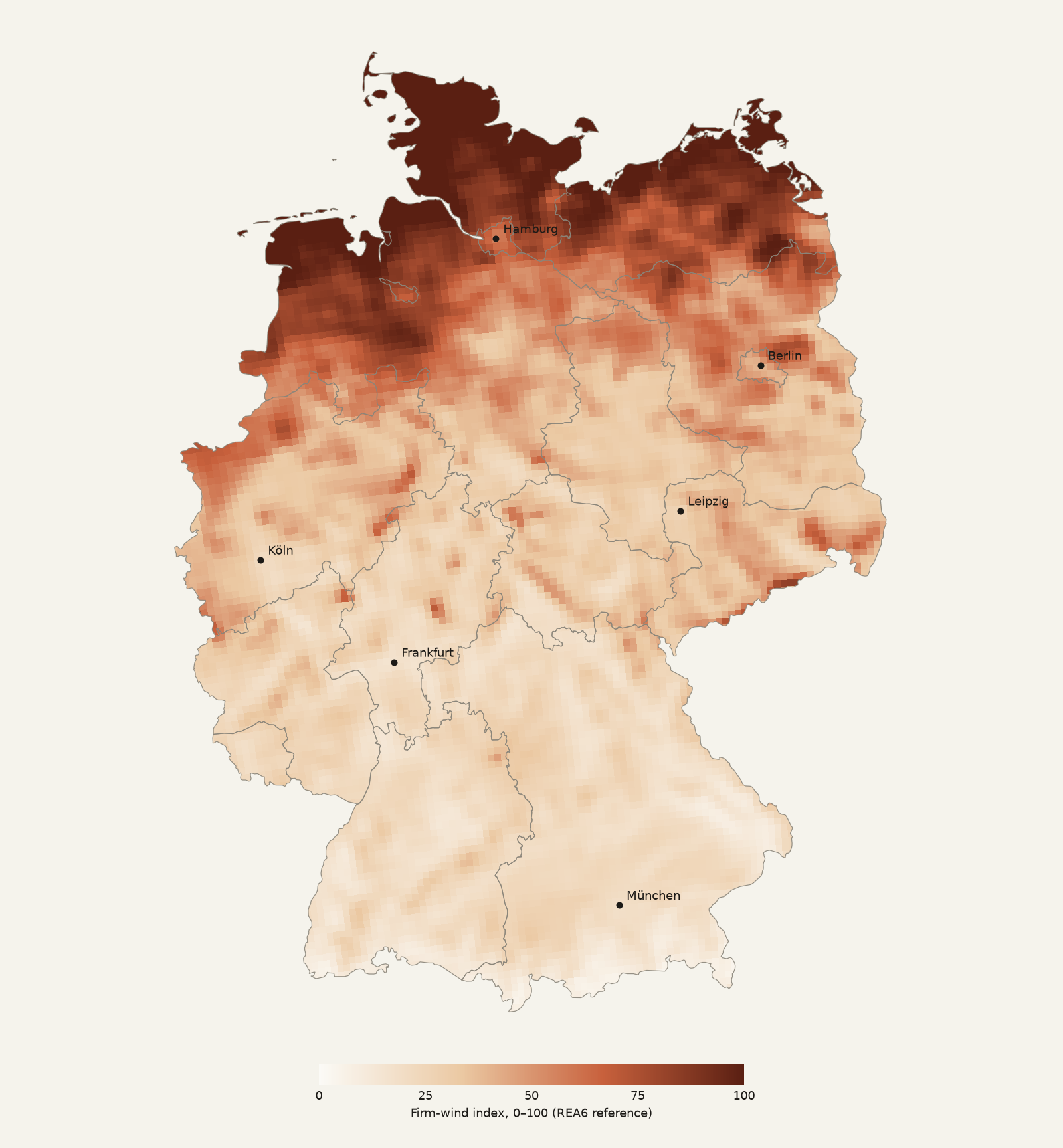
Map of Germany with Länder borders at six-kilometre resolution, coloured by a firm-wind index from 0 to 100: deep terracotta along the North Sea and Baltic coasts and across the North German Plain, fading to cream over the uplands and the south.

Where the wind is good for a farm

A firm-wind index for Germany, 1995–2019, at 6 km

100 = the best five percent of German cells in this dataset; the score weighs energy yield (0.5), firmness of the bad days (0.3) and persistence of calm (0.2). Drawn on the German Weather Service's regional reanalysis COSMO-REA6 at six kilometres, 9,534 cells.

COSMO-REA6 publishes daily means of 100 m wind through a generic, uncalibrated power curve, so the energy term under-counts gusty days; the index is scaled to this dataset's own best cells and compares in pattern, not in points, with the ERA5 version. A then-versus-now version on ERA5 (1981–1990 against 2015–2025) was built and then checked against 118 long DWD station records: the stations do not confirm the reanalysis change (rank correlation −0.10, same sign in 49 % of stations), so that map stays unpublished. What is published is the check.

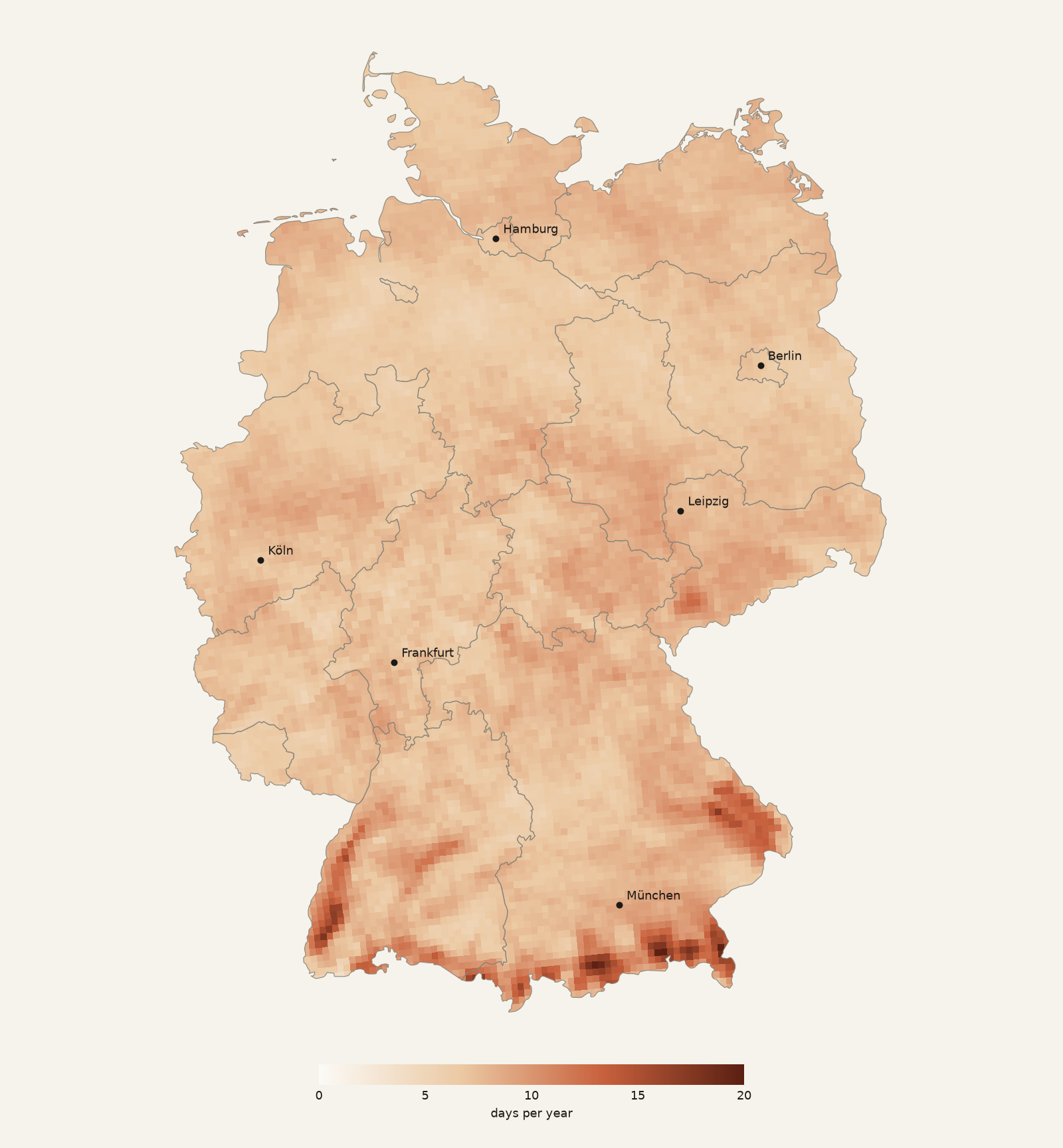
Map of Germany with Länder borders at six-kilometre resolution, coloured by wind-drought days per year from 0 to 20: the Alps, the Black Forest and the Bavarian Forest darkest, the North German Plain lightest.

Where the calm lives

Wind-drought days per year, 1995–2019, at 6 km

A drought day sits below the cell's own 10th-percentile daily wind inside a spell of at least three days — the same convention as the Opinion #001 series. Drawn on the German Weather Service's regional reanalysis COSMO-REA6 at six kilometres, which resolves the calm pockets of the Alps, the Black Forest and the Bavarian Forest that a 25-kilometre reanalysis smears away.

COSMO-REA6 publishes daily means and ends in August 2019; the then-versus-now comparison therefore stays on ERA5.

Data: ERA5 (Copernicus Climate Change Service, CC-BY-4.0), pulled July 2026; COSMO-REA6 regional reanalysis (Deutscher Wetterdienst open data, free use with attribution), pulled October 2026; borders: Natural Earth (public domain). Static exhibits, dated; re-drawn when the next full year lands.

Disclaimer — published in a personal capacity, under my own name. This is independent work: produced entirely on my own time and my own equipment, from public data (ERA5 reanalysis; ENTSO‑E generation), using no resources, data, or working time of any employer, and outside my assigned duties. It carries no institutional affiliation and is neither connected with nor endorsed by any employer or institution; the views are mine alone. It is not financial, actuarial, or legal advice, and nothing here is an offer of services.

Basis risk in parametric insurance: a working definition

Publications

Every peer-reviewed article and book chapter, newest first. Titles and journal names as published, in English. The current citation record lives on Google Scholar; preprints, abstracts, datasets and software stay on ORCID.

2026
  1. Climate Change in Central Asia and Expected Impacts B. Fallah Towards Sustainable Future of Central Asia: Analysis of Climate, Resources and Human Security (Springer, Advances in Global Change Research 84), 21–47doi:10.1007/978-3-032-29989-5_2 open access book chapter
  2. Towards a theoretical understanding of Arctic amplification dynamics M. Rostami, B. Fallah, F. Fazel-Rastgar, M. Hamidi, S. Hariri, J. Guo, L.-Y. Fu npj Climate and Atmospheric Science 9, 173doi:10.1038/s41612-026-01439-z open access
  3. A Case Study of the June 2024 Extreme Heat Disaster in Saudi Arabia: Influence of Atmospheric Shifts on Regional Heatwaves F. Fazel-Rastgar, S. Khansalari, V. Sivakumar, M. Rostami, B. Fallah Disaster, Crisis and Emergency Management in the Middle East and North Africa (Springer), 383–400doi:10.1007/978-3-032-24436-9_17 book chapter
2025
  1. Unveiling meteorological synergies in the coupling of an abnormal easterly wave and cutoff low in South Africa's February 2023 rainfall F. Fazel-Rastgar, V. Sivakumar, M. Rostami, B. Fallah Meteorological Applications 32(1)doi:10.1002/met.70027 open access
  2. Torrential rainfall with severe flooding associated with a baroclinic disturbance on November 17, 2023, United Arab Emirates (UAE) F. Fazel-Rastgar, M. Rostami, B. Fallah, V. Sivakumar International Journal of River Basin Management 24(4), 677–686doi:10.1080/15715124.2025.2462575 open access
  3. Study on associated effects of extreme drought and heatwave on air quality in South Africa during october 2022 F. Fazel-Rastgar, V. Sivakumar, M. Rostami, B. Fallah Bulletin of Atmospheric Science and Technology 6(1)doi:10.1007/s42865-025-00101-5 open access
  4. Investigation of the role of southwestern Asia dust events on urban air pollution: a case study of Ahvaz, a highly polluted city M. Hamidi, T. Ghobadi, Y. Shao, B. Fallah, M. Rostami, R. Mao Scientific Reports 15(1), 21981–21981doi:10.1038/s41598-025-07634-x open access
  5. From drought to deluge: Understanding the atmospheric and climatic forces behind the United Arab Emirates' recent flood event F. Fazel-Rastgar, M. Rostami, V. Sivakumar, B. Fallah Journal of Atmospheric and Solar-Terrestrial Physics 278, 106712–106712doi:10.1016/j.jastp.2025.106712
  6. Decadal changes in meteorological extremes and environmental consequences in the Caspian Sea Region F. Fazel-Rastgar, V. Sivakumar, M. Rostami, B. Fallah Discover Atmosphere 3(1)doi:10.1007/s44292-025-00055-5 open access
  7. Climate model downscaling in central Asia: a dynamical and a neural network approach B. Fallah, M. Rostami, E. Russo, P. Harder, C. Menz, P. Hoffmann, I. Didovets, et al. Geoscientific Model Development 18(1), 161–180doi:10.5194/gmd-18-161-2025 open access
  8. Aeolus 2.0's thermal rotating shallow water model: A new paradigm for simulating extreme heatwaves, westerly jet intensification, and more M. Rostami, S. Petri, B. Fallah, F. Fazel-Rastgar Physics of Fluids 37(1)doi:10.1063/5.0244908 open access
  9. A novel sea surface evaporation scheme assessed by the thermal rotating shallow water model M. Rostami, S. Petri, B. Fallah, F. Fazel-Rastgar Atmospheric Science Letters 26(1)doi:10.1002/asl.1287 open access
2024
  1. Open-source stand-alone version of atmospheric model Aeolus 2.0 software M. Rostami, S. Petri, S. O. Guimarães, B. Fallah Geoscience Data Journaldoi:10.1002/gdj3.249 open access
  2. High-resolution CMIP6 analysis highlights emerging climate challenges in alpine and Tibetan Tundra zones B. Fallah, M. Rostami, I. Didovets, Z. Dong Meteorological Applications 31(5)doi:10.1002/met.70001 open access
  3. Exploring the impact of the recent global warming on extreme weather events in Central Asia using the counterfactual climate data ATTRICI v1.1 B. Fallah, M. Rostami Climatic Change 177(5), 80doi:10.1007/s10584-024-03743-0 open access
  4. Dynamics of Jupiter’s equatorial zone: Instability analysis and a mechanism for Y-shaped structures M. Rostami, B. Fallah, F. Fazel-Rastgar Icarus 429, 116414doi:10.1016/j.icarus.2024.116414 open access
  5. Climate change impacts on Central Asia: trends, extremes and future projections B. Fallah, I. Didovets, M. Rostami, M. Hamidi International Journal of Climatology 44(10), 3191–3213doi:10.1002/joc.8519 open access
  6. Attribution of current trends in streamflow to climate change for 12 Central Asian catchments I. Didovets, V. Krysanova, A. Nurbatsina, B. Fallah, V. Krylova, A. Saparova, J. Niyazov, O. Kalashnikova, F. F. Hattermann Climatic Change 177(1)doi:10.1007/s10584-023-03673-3 open access
2023
  1. Anthropogenic influence on extreme temperature and precipitation in Central Asia B. Fallah, E. Russo, C. Menz, P. Hoffmann, I. Didovets, F. F. Hattermann Scientific Reports 13(1), 6854doi:10.1038/s41598-023-33921-6 open access
2022
  1. The long-standing dilemma of European summer temperatures E. Russo, B. Fallah, P. Ludwig, M. Karremann, C. C. Raible Climate of the Past 18(4), 895–909doi:10.5194/cp-18-895-2022 open access
2018
  1. Towards high-resolution climate reconstruction using an off-line data assimilation method B. Fallah, E. Russo, W. Acevedo, A. Mauri, N. Becker, U. Cubasch Climate of the Past 14(9), 1345–1360doi:10.5194/cp-14-1345-2018 open access
2017
  1. Assimilation of pseudo-tree-ring-width observations into an atmospheric general circulation model W. Acevedo, B. Fallah, S. Reich, U. Cubasch Climate of the Past 13(5), 545–557doi:10.5194/cp-13-545-2017 open access
2016
  1. Emergence of global scaling behaviour in the coupled Earth-atmosphere interaction B. Fallah, A. A. Saberi, S. Sahar Scientific Reports 6, 34005doi:10.1038/srep34005 open access
2015
  1. Westerly jet stream and past millennium climate change in Arid Central Asia simulated by COSMO-CLM model B. Fallah, S. Sodoudi, U. Cubasch Theoretical and Applied Climatology 124(3), 1079–1088doi:10.1007/s00704-015-1479-x open access
  2. Towards modeling the regional rainfall changes over Iran due to the climate forcing of the past 6000 years B. Fallah, S. Sodoudi, E. Russo, I. Kirchner, U. Cubasch Quaternary International 429, 119–128doi:10.1016/j.quaint.2015.09.061 open access
  3. Bimodality and regime behavior in atmosphere–ocean interactions during the recent climate change B. Fallah, S. Sodoudi Dynamics of Atmospheres and Oceans 70, 1–11doi:10.1016/j.dynatmoce.2015.02.002 open access
  4. A numerical model study on the behaviour of Asian summer monsoon and AMOC due to orographic forcing of Tibetan Plateau B. Fallah, U. Cubasch, K. Prömmel, S. Sodoudi Climate Dynamics 47(5), 1485–1495doi:10.1007/s00382-015-2914-5 open access
  5. A comparison of model simulations of Asian mega-droughts during the past millennium B. Fallah, U. Cubasch Climate of the Past 11(2), 253–263doi:10.5194/cp-11-253-2015 open access
2014
  1. Regional moisture change over India during the past millennium: a comparison of multi-proxy reconstructions and climate model simulations S. Polanski, B. Fallah, D. J. Befort, S. Prasad, U. Cubasch Global and Planetary Change 122, 176–185doi:10.1016/j.gloplacha.2014.08.016 open access

Books

Work that is not a paper. A book can carry an argument to a reader who would never open a journal, and it can be held to the same standard on the way — every number computed rather than recalled.

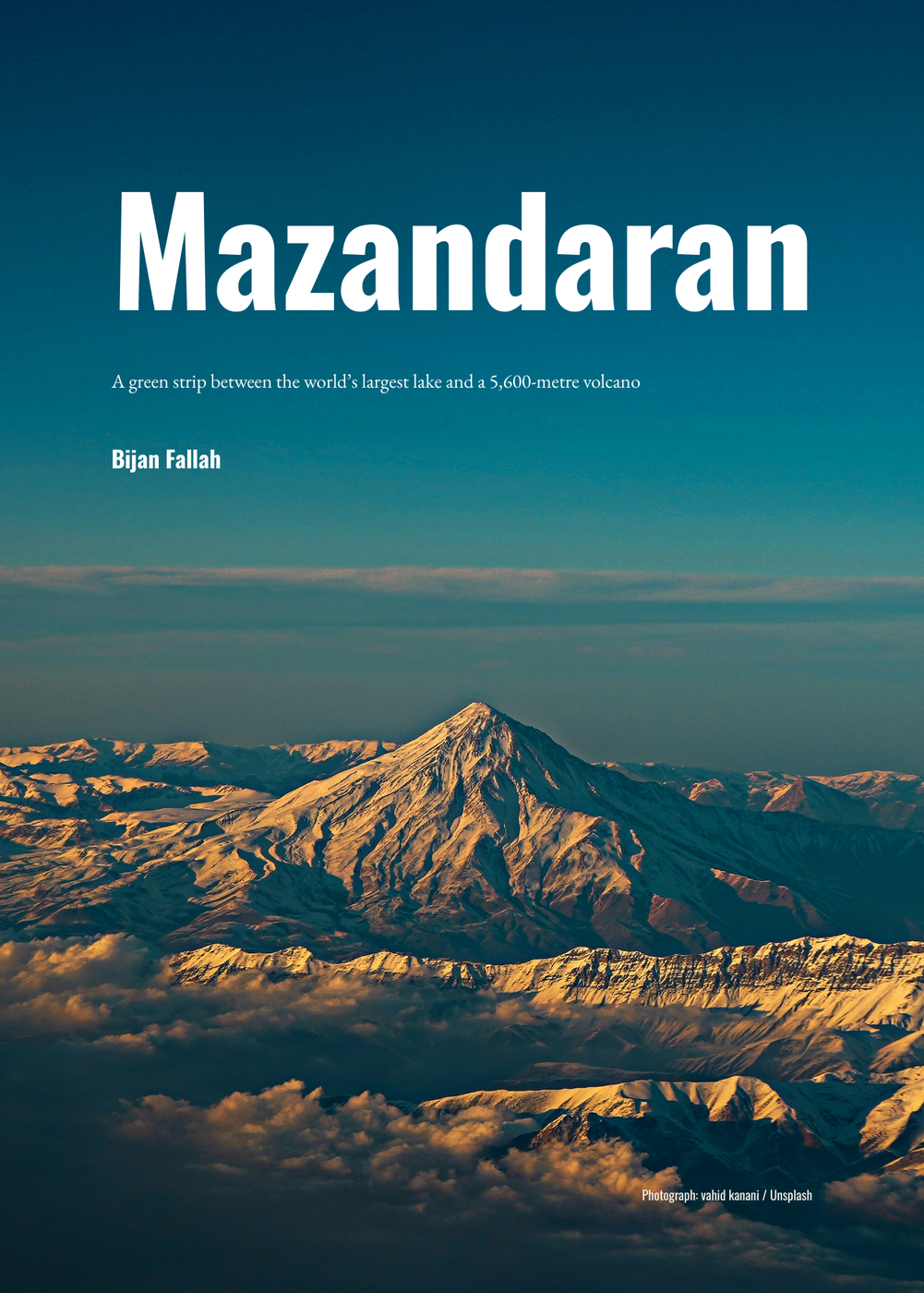
Cover of the book Mazandaran: the snow-covered cone of Damavand rising above a cloud layer at dawn, under a deep blue sky.

Mazandaran — a climate atlas

B. Fallah · Zenodo, version 2.0.0 · 48 pages, 170 × 240 mm

Download the PDF — 23 MBZenodo record

Mazandaran is the province I am from: a strip of Iran between the Caspian, which is the largest lake on earth, and the Alborz, which carries a 5,600-metre volcano. A European reader tends to picture Iran as desert. The book answers that with arithmetic rather than protest — Ramsar takes 1,238 mm of rain a year on 89 rain days, against Hamburg's 771 mm on 188; two thirds of the province lies above 500 m; and the forest on its slopes held beech, oak, elm and hornbeam through the last glacial, while Europe was steppe and tundra.

Every number printed on a plate was computed from open data by the pipeline published with the book, and stored with the method that produced it. Every claim that is not a number resolves to a source with a retrieval date. Ninety acceptance checks run on each build, and the one that still fails is named on the last page instead of hidden. Where the data cannot answer, the book says so: all four rain gauges in the province sit at sea level, so above 500 m the rainfall map is a model no gauge has checked, and the plate says that.

Text, maps and design CC BY 4.0; the code MIT; the two photographs under the Unsplash License and not sub-licensable. Free to read, translate and reprint, with credit.

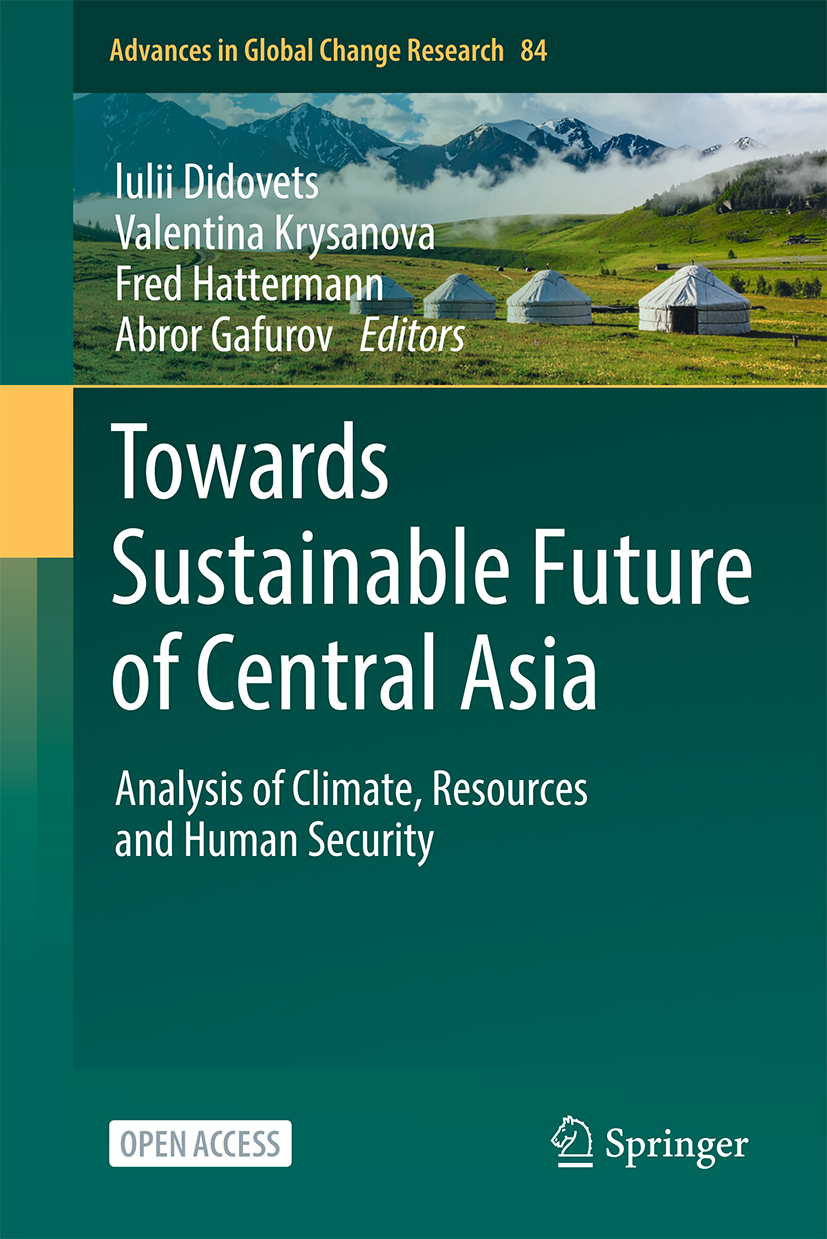
Cover of the book Towards Sustainable Future of Central Asia: yurts on a green summer pasture below snow-capped mountains, the title in white on dark green.

Climate Change in Central Asia and Expected Impacts

B. Fallah · Chapter 2 in: I. Didovets, V. Krysanova, F. F. Hattermann, A. Gafurov (eds.), Towards Sustainable Future of Central Asia: Analysis of Climate, Resources and Human Security · Springer Nature, Advances in Global Change Research 84 · pp. 21–47 · open access

Download the chapter PDF — open accessChapter at Springer

Central Asia warms faster than the planet. The chapter sets out why — a continental interior far from any ocean, with mountains that amplify the warming with height — and what the record already shows: surface air temperature about 1.2 °C above the pre-industrial baseline, and under the high-emission pathway SSP5-8.5 a rise approaching 6 °C by the end of the century. The projections rest on 442 CMIP6 simulations, downscaled to the region with a neural network.

The second half is about what that heat does to water. The glaciers of the Tien Shan have lost about 27 % of their mass since 1961, and 22 million people downstream depend on the meltwater they buffer; roughly 80 million live on the balance between glacial melt and river flow. Extremes that were rare are no longer: multi-year droughts have become seven times more frequent, and in 2024 rapid snowmelt on saturated soil flooded Kazakhstan and displaced 118,000 people. The chapter is open access, as is the whole volume.

Open access under CC BY 4.0 — free to read, share and adapt, with credit. Chapter 2 of a volume on climate, water and human security in Central Asia, edited by I. Didovets, V. Krysanova, F. F. Hattermann and A. Gafurov.

The books on their own page →

Spoken

Contact

Email is the surest way to reach me — I read everything, and I answer most things within a week.