Note · 2026-08-04
Malawi 2016, re-examined: what a famous insurance failure still teaches every weather trigger
In the 2015/16 growing season, Malawi suffered one of its worst droughts in decades, and millions faced food insecurity. The country also held a parametric drought-insurance policy through the African Risk Capacity (ARC) — the kind of cover that is meant to pay out automatically when a weather model says a drought has occurred, without waiting for anyone to survey the fields.
At first, the model said almost nothing was owed. Then, after the assumptions inside it were revisited — in particular the length of the maize growing cycle it assumed — the same season produced a payout of roughly US$8m.
That episode became one of the most-discussed cautions in the parametric world. To critics it looked like the goalposts had moved. To others it showed a model that had simply been mis-specified for Malawi's actual crop calendar, and was then corrected. Either way, one uncomfortable question hung in the air: how can the same drought be worth almost nothing and then worth millions, depending on a modelling choice?
I went back to the data to ask a narrower, cleaner version of that question — independently, from public sources, with no stake in the answer.
The two things worth separating
A parametric payout is the product of two things: the weather that actually happened, and the model that turns that weather into an assumed loss. When a payout is disputed, the useful question is which of the two is doing the work. So I asked:
- In the rainfall record itself, was 2015/16 genuinely an extreme season — or a borderline one that only crossed the line because of a modelling tweak?
- Did the answer to (1) depend on the disputed assumption — the crop-cycle length?
I rebuilt the growing-season (November–April) rainfall for the maize region from ERA5-Land, a public reanalysis dataset, across 34 years, and ranked 2015/16 against every other season.
What the data says
2015/16 was a real and severe drought. It came out as the 6th-driest November–April season in 34 years — around the 10th percentile. This was not a borderline event dressed up by a model; the dryness is in the rainfall record, plainly.
And the drought did not depend on the disputed assumption. When I varied the assumed crop-cycle length across the whole plausible range, 2015/16 stayed in the driest tenth of seasons every single time — a flat 3rd-to-13th-percentile band. No matter which crop calendar you assume, the season reads as a serious drought.
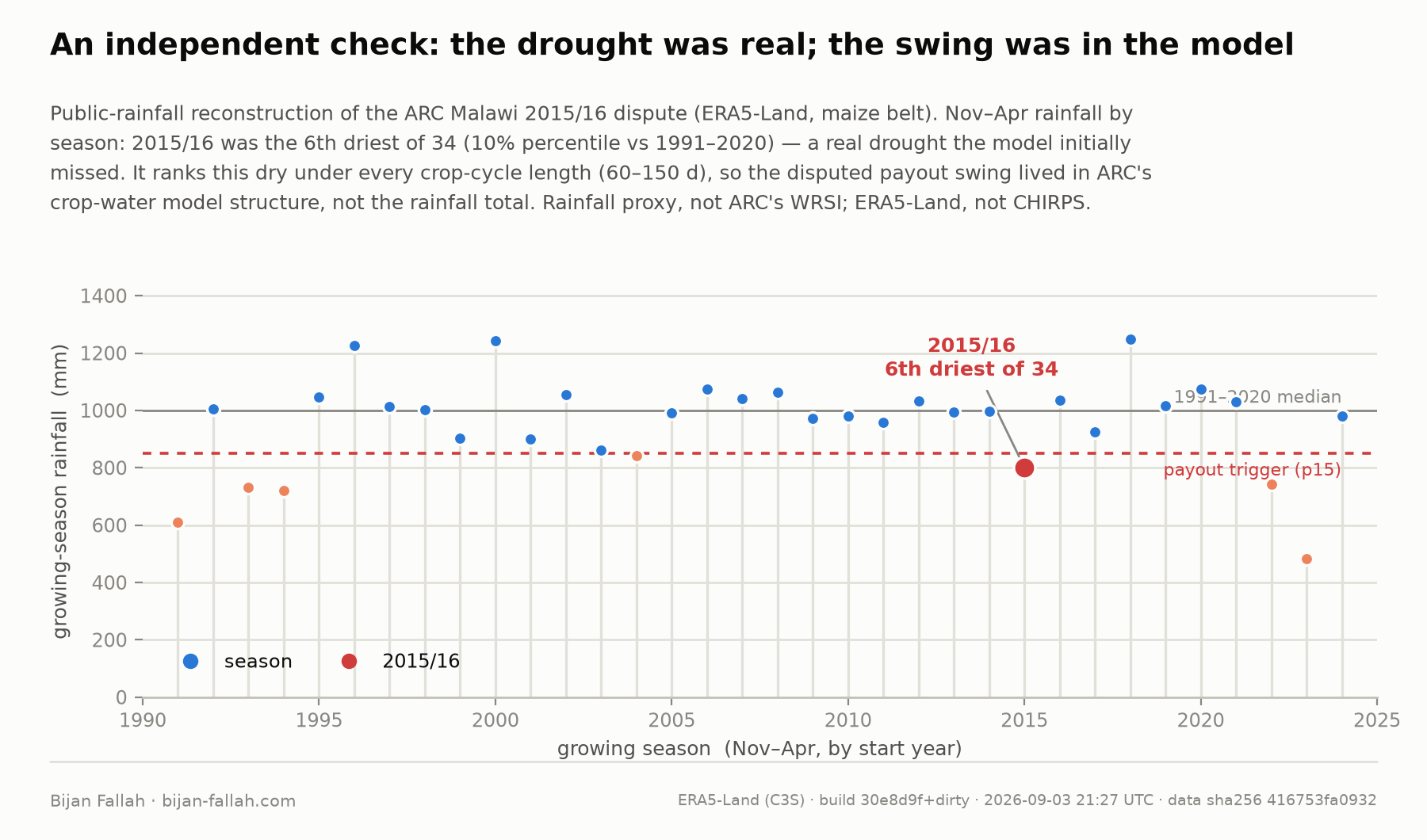
Put those together and something clarifying falls out. The payout swung from near-zero to US$8m, but the underlying drought did not swing at all. The rainfall was extreme under every assumption. So the thing that moved the payout was not the weather, and not really the rainfall threshold — it lived in the structure of the crop-water model sitting between the two.
Why this matters far beyond Malawi
It's tempting to file this as a one-off: a first-generation drought product that got recalibrated. I think that reading misses the general lesson — and the general lesson is the whole point of the work I'm building:
Calibration is necessary but not sufficient. Once a trigger is calibrated, the risk that survives lives in the model's structure — and that is exactly where it is hardest to see.
You can tune any weather index until its past payouts match past losses on average. That tuning is real work and it matters. But it doesn't tell you how the index behaves in the events you haven't seen yet, or whether the shape of the model — its assumptions about how weather becomes loss — matches the thing you're actually insuring. A perfectly calibrated trigger can still miss the losses that matter most.
I've since measured exactly this on a completely different peril — European wind and solar "resource drought," where a farm underperforms because the wind or sun didn't show up. There, even an index re-tuned to be perfectly fair on average still leaves a large, structural slice of the loss unpaid, concentrated in the deepest events. Different continent, different peril, the same shape of problem. Malawi isn't an African-agriculture story. It's a parametric-insurance story.
What this doesn't show
This is an independent re-analysis on public data, and it's deliberately scoped. I used ERA5-Land, not the specific satellite rainfall product ARC uses; monthly rather than ten-day data; and a rainfall proxy rather than the full crop-water model. So it does not reconstruct ARC's exact calculation, and isn't meant to. It answers one question cleanly — was the drought real and robust, or an artifact of a modelling choice? — and the answer is that the drought was real and robust, which is what lets us locate the dispute where it actually belongs: in the model's structure, not in the sky.
This is the first in a series asking the same question — how well does a weather trigger actually track the loss it's meant to cover? — and taking it into European renewable-energy risk. The full technical write-up ("Opinion #001") follows later in this series. If you build, buy, or carry parametric weather risk, I'd genuinely like to hear how this looks from your side of the market.
Disclaimer — published in a personal capacity, under my own name. This is independent work: produced entirely on my own time and my own equipment, from public data (ERA5‑Land reanalysis), using no resources, data, or working time of any employer, and outside my assigned duties. It carries no institutional affiliation and is neither connected with nor endorsed by any employer or institution; the views are mine alone. It is not financial, actuarial, or legal advice, and nothing here is an offer of services.